


Receiving a Cancer diagnosis can be life-changing.
One of the most challenging issues for parents is finding the right way to explain the diagnosis and what lies ahead to their entire family, particularly children.
To mark World Cancer Day, staff at the South Eastern Trust’s Macmillan Cancer Unit are highlighting the support available to help families navigate these difficult but vital conversations.
South Eastern Trust, Haematology/Adolescent and Young Adult Clinical Nurse Specialist in the Macmillan Cancer Unit, Lisa Callender explained how the Team provides guidance, support and signposting to parents faced with the prospect of explaining a cancer diagnosis to their children.
“As we mark World Cancer Day, it is important to remember that Cancer does not just affect the patient, it also affects their families, including children, young people and Grandparents.
“It is important to remember that children and young people are always listening and always picking up subtle clues. It is not always what you say but how you say it. We would encourage patients to explain what their diagnosis is and how this is going to impact them going forward.”
Lisa stressed the importance of honesty when explaining a Cancer diagnosis to a child or young person. “Children do not tend to live in shades of grey, they see things in black and white. They respond much better when you are honest with them. The best place for a child or young person to get information is from the people they trust and love the most, their parents or carers.”
One of the many things a Cancer diagnosis brings is uncertainty. Lisa emphasised the importance of helping children understand what to expect. “It is important for children to know that Mummy or Daddy may go through some difficult times. Their appearance might change, they may be feeling very sick and have less energy, but they haven’t changed who they are. They are still Mummy, they are still Daddy. They are still the person that brought you into this world. They are the person who got on their hands and knees and played with you or chased you around the park. They might not be able to do that as well as they have done in the past but they are still here and will want to do that again in the future.”
Macmillan Health and Wellbeing Co-ordinator, Karen Kelly highlighted the role of the Support Centre within the Unit, which provides a wide range of information and practical help for families. “Receiving a Cancer diagnosis can be incredibly challenging on a personal level. It is not a standalone experience, it affects the people closest to you and those you love most.
“It is not uncommon for us to meet people who are overwhelmed by the thought of having that conversation with their children. Parents are often very aware of how a child might cope with the diagnosis and how it could affect the whole family.”
Karen explained that the Unit recognises how crucial it is for families to receive the right support at the right time. “We can offer parents the opportunity to bring their children into the Unit, show them around and help them understand where Mum and Dad are going to be. This can help reduce fear of the unknown and make the experience less daunting.”
Karen continued, “We talk to parents about the importance of being open with their children. Many parents want to be honest but often struggle to find the words and they just appreciate a little bit of guidance.
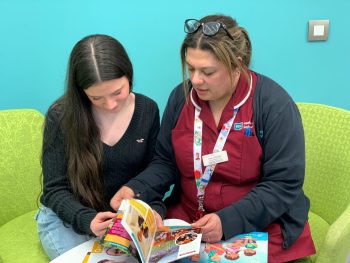
“We provide literature and booklets which help parents begin those conversations in a way that is appropriate for the child or young person. When it comes to a Cancer diagnosis, it’s not always what you say, it is how you say it. We encourage the use of plain language and avoiding sugar coating the situation.
Karen encouraged anyone with concerns about talking to their children about a cancer diagnosis to reach out for support. “There is so much we can do to help both you and your family. We can provide information, practical tools and guide families to professionals with expertise in supporting children and young people through this experience.
“We all know that children can pick up so much and they can become very aware when they feel something is being hidden from them. When parents whisper, children listen harder. Being clear and honest from the beginning helps children feel included and makes them feel safe, knowing they understand what is happening.”