


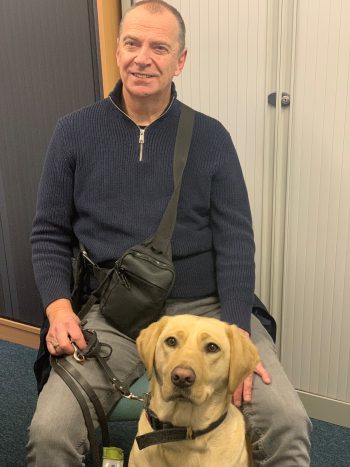
Following a devastating diagnosis of degenerative sight loss, Ken Carson has praised the emotional, practical and mental health support provided by the South Eastern Trust’s Sensory Support Team, describing it as life-changing and instrumental in helping him learn to “live with sight loss.”
Ken who is from Bangor, was first diagnosed with Optic Neuritis in 2001 following a routine eye examination and subsequent investigations. Optic Neuritis is an inflammation of the optic nerve which can cause eye pain, blurred vision, loss of colour vision and eventually vision loss.
While Ken managed for a number of years, his sight deteriorated rapidly following a mini-stroke in 2015, significantly impacting his independence and day-to-day life.
Ken explained, “My Consultant at the time contacted the Sensory Support Team and a Rehabilitation worker came out to see me at home. They were able to help me with specific equipment including lighting, magnifiers and long cane training.”
Reflecting on that period, Ken said, “I realised then that, for me, the future was looking bleak, it was dark. I suppose it was the fear of the unknown, as I did not know what lay ahead.”
Ken credits the ongoing support and expertise of Sensory Support Team Social Worker Barbara Gracey, with helping him come to terms with his sight loss and rebuilding his confidence.
“I was brought from a very dark place to a place where I was living with sight loss. Through Barbara’s support, I was able to start a healing process and accept what was happening to me.”
Although Ken now has limited sight, he takes reassurance from knowing that support is close at hand, “Barbara is always just at the end of a phone call. She has taught me the skills to manage the emotional and mental health dips. Living with sight loss is an emotional rollercoaster.”
With his trusted Guide Dog companion Waffle, by his side, Ken now leads a very active life. “I play blind golf, blind tennis and I go swimming. I also manage four visually impaired groups, an audio book club and a history club. Without that initial support from the Sensory Support Team, there would have been no chance of me achieving any of that.”
Ken also volunteers with RNIB and Guide Dogs NI and is passionate about encouraging others to seek help early.
“It is vital for anyone experiencing sight loss or hearing loss to have support from the very beginning. The confidence to do and take part in so much was given to me by the Sensory Support Team. They are a small Team, but they make such a big, big difference to people’s lives. They have made such a huge difference to me and I am just loving life!”
Barbara Gracey explained how the service supports people with significant sensory loss, “We work with people who have significant sight loss that cannot be corrected with glasses, as well as people who are deaf, hard of hearing or experience Tinnitus.
“Across the three Teams we have a mixture of Social Workers, Rehabilitation Workers, a Peer Support Worker, an Environmental Technical Officer and Team Secretaries. Our Rehabilitation Workers focus on the practical side of promoting independence and wellbeing, including teaching new skills and supporting the use of equipment and technology.”
Barbara added, “As a Social Worker, I provide emotional support and help people come to terms with their sight loss. We also look at housing, education, training, finances, social isolation and sign posting to other appropriate services. People can self-refer to our service or they can be referred by their GP or health professional, family member or friend, as long as the person gives their permission.”
“To see someone make that transition, whether it is sight or hearing loss and to be able to give a person hope again is very encouraging and especially rewarding to see that progress made.”
For further information on the South Eastern Trust Sensory Support Team email sensorysupport@setrust.hscni.net