


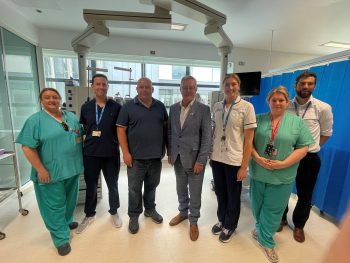
Health Minister Mike Nesbitt MLA, has visited the Critical Care Recovery Clinic at the Ulster Hospital to meet the Multi-disciplinary Team behind the service and hear first-hand how it is helping former Intensive Care patients rebuild their lives after a critical illness.
The South Eastern Trust was one of the first Trusts in Northern Ireland to establish the Critical Care Recovery Clinic. Since it started in 2011, the clinic has supported around 650 patients as they recover from the physical, psychological and emotional impact of a stay in the Intensive Care Unit.
During the visit, the Health Minister met former Intensive Care patient, Adam Bayliss, who has credited the clinic with helping him to understand his experience in the Unit and the life-changing impact the clinic has had on his recovery.
In December 2025, Adam was admitted to the Ulster Hospital after developing Pneumonia which led to Sepsis, multiple organ failure and blood clots. He spent 11 weeks in hospital, much of that time on a ventilator while staff worked tirelessly to save his life.
Now, eight months on, Adam has returned to work on a phased basis and continues to rebuild his strength with the support of the Critical Care Recovery Clinic.
Held once a month, the clinic welcomes up to four former ICU patients at each session. Patients who are most likely to benefit are identified using agreed referral criteria and receive a comprehensive review from the Multi-disciplinary Team. Where appropriate, further follow-up with Psychology Services is arranged to ensure patients continue to receive the support they need.
The dedicated Multi-Disciplinary Team comprises an ICU Consultant, ICU Nurse, Pharmacist and Physiotherapist, the clinic offers a holistic approach to recovery. Patients receive emotional support, rehabilitation advice, medication reviews and the opportunity to discuss their treatment and recovery with the staff who cared for them during their time in ICU.
For many people, like Adam, leaving Intensive Care is only the beginning of their recovery. Critical illness can leave lasting physical, emotional and psychological effects, with many patients having little or no memory of their time in Intensive Care due to the severity of their illness and the treatments they received.
A unique aspect of the clinic is the opportunity for patients and their families to return to the Intensive Care Unit, meet the staff who cared for them and revisit the bed space where they received treatment. For many, this helps answer unanswered questions, fill gaps in their memory and come to terms with what has often been one of the most traumatic experiences of their lives.
Adam highlighted to the Health Minister the benefit the clinic has had on his recovery, “When I came to the Recovery Clinic, it gave me real insight into what had happened during my stay in Intensive Care. There were so many things I could not remember because I had been in a coma, and the Team took the time to explain everything, including the treatment I received and how far I had come in my recovery.
“The clinic has been such an important part of my journey. It has helped me understand what happened, supported me through my recovery and given me confidence to keep moving forward. Returning to work after eight months has been an incredible milestone for me. My body is still recovering, but it feels good to be getting back into a routine and looking to the future with a positive outlook.
“It was wonderful to return to the Unit today and meet the Minister alongside the staff who cared for me. They are almost like family. They want you to recover, they encourage you every step of the way and they celebrate every milestone with you. I could not ask for more.”
Health Minister, Mike Nesbitt said, “For many patients, recovery continues long after they leave hospital. There are often gaps in memory and physical and psychological challenges that need ongoing support.
“The Critical Care Recovery Clinic recognises that recovery is about much more than surviving critical illness. It gives patients the opportunity to understand what happened to them, ask questions and receive the support they need as they rebuild their lives.
“Meeting Adam today really brought home the importance of this service. Hearing about everything he has been through, from being critically ill to returning to work, demonstrates the difference this clinic is making. Visits like this remind me that behind every service, are dedicated staff whose compassion and expertise help patients recover and move forward with their lives.”
Welcoming the Minister to the Intensive Care Unit, South Eastern Trust, Director of Unscheduled Care, Medicine and Cancer Services, Marc Neil stated, “It was a pleasure to welcome the Minister to the Intensive Care Unit and to share the journey our patients take, from the moment they arrive critically ill, through their treatment and rehabilitation and ultimately back into the community.
“One of the most rewarding aspects of the Critical Care Recovery Clinic is seeing patients return to tell their stories. Our staff care for people at the sickest point in their lives and it is incredibly special to see them come back, recovering and rebuilding their lives.
“This visit gave the Minister the opportunity to hear directly from both staff and patients about the lasting impact of the clinic. It was a powerful reminder that excellent critical care does not end when a patient leaves Intensive Care. Supporting recovery beyond hospital is every bit as important.”
South Eastern Trust, Intensive Care Physiotherapist, Katie Campbell added, “The Recovery Clinic was established to ensure that patients who survive a stay in Intensive Care continue to receive the support they need after leaving hospital. It has been a privilege to be part of the clinic since its early years. It was the first dedicated service of its kind in Northern Ireland and continues to demonstrate the value of supporting patients beyond their hospital stay.
“For many patients, returning to the Intensive Care Unit and seeing the environment where they were treated helps them make sense of memories that may have been confusing or incomplete. It allows them to put the pieces together, come to terms with what happened and move forward with their recovery. Seeing patients like Adam return to work and rebuild their lives is exactly why this clinic is so important.”