


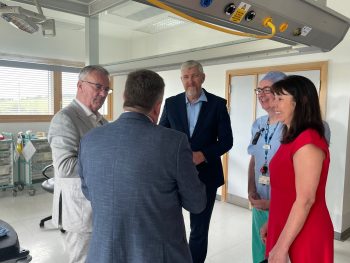
Health Minister Mike Nesbitt, MLA and Finance Minister, John O’Dowd MLA have visited the Day Procedure Unit in the Downe Hospital to see how £80 million of Executive investment in elective care is helping to reduce waiting times and increase access to treatment for patients across Northern Ireland.
75 year old Pamela Cullinan, who lives in North Belfast, had just undergone a Cataract procedure and was able to tell the Ministers how it had changed her life.
Pamela said, “Having had Cataract surgery, the difference is between night and day. Living permanently in darkness is very difficult. I could not see my grandchildren’s faces.
“You cannot see distinctly. I could make out shapes of people but you cannot distinguish one thing from another. I am looking forward to being able to do my sewing and getting back to knitting and crochet again. They are crafts I really enjoy.
“The surgery has truly changed my life. I would say 99.9%. It has been truly wonderful.”
The Ministers were joined by Professor Mark Taylor, Regional Clinical Director for Elective Care, where they met staff and patients and saw first-hand the impact of investment in Cataract, Glaucoma and Endoscopy Services.
The Downe Day Procedure Unit delivers a range of Ophthalmology and Endoscopy procedures alongside other minor surgical procedures, many of which are carried out under local anaesthetic.
The Unit is home to one of Northern Ireland’s three Regional Cataract Day Procedure Centres, alongside Mid-Ulster Hospital and South Tyrone Hospital. Seven Cataract lists are delivered each week at the Downe Hospital, with around 2,300 patients treated annually.
The service has also expanded its Glaucoma provision through additional outreach sessions and has successfully hosted Independent Sector Cataract providers at weekends, increasing capacity, productivity and theatre utilisation.
The Cataract Centres were among the original prototypes for the Day Procedure Centre model which has since been adopted across a range of specialties and procedures.
The investment forms part of the Executive’s Programme for Government and Elective Care Framework which is supporting increased capacity for time-critical Glaucoma Services alongside targeted reductions in waiting times for high-volume adult Ophthalmology procedures.
Health Minister Mike Nesbitt said, “I was very impressed with what I saw at the Downe Hospital today. If you have Cataracts, it is like looking at the world through frosted glass and it has a real impact on your quality of life and your mental health.
“They are doing fabulous work here in the Downe Hospital, both in terms of the quantity and quality of care being delivered. This is one of three centres across Northern Ireland specialising in Cataract treatment and it is making a real difference to people’s lives.
“It is only real when I am out and about visiting Health and Social Care settings. The discussions around the Executive table about budgets and everything else are really important, but it does not become real unless you get to see it.
“I think that is what John experienced today, coming along as Finance Minister to see the actual impact on real people of his budgetary decisions.”
South Eastern Trust, Chief Executive, Roisin Coulter, welcomed the Ministers to the Downe Hospital and highlighted the importance of sustained investment in elective care.
Roisin added, “We were absolutely delighted to welcome both Ministers to the Downe Hospital to see the Day Procedure Unit and the work our staff are doing to deliver high-quality Regional Cataract Services.
“The ring-fenced funding for elective waiting lists is hugely important. People have been waiting a long time for treatment and our focus must remain on reducing those waits and improving access to care.
“Today was an opportunity to demonstrate what can be achieved when investment is combined with the commitment and expertise of our staff. We want to continue building on that progress for the benefit of our patients.”
Professor Mark Taylor said the investment was already making a significant difference to services at the Downe, “It was really important for staff to see the Minister of Finance and Minister of Health together because we need both. We need the funding and we are grateful for the £80 million of ring-fenced funding which will make a real difference here in Downpatrick, including the expansion of Glaucoma Services.
“It also demonstrates that when the Executive works together with us in the hospital environment, we can deliver meaningful improvements in waiting times.
“I am incredibly proud of what I have seen today in the Downe Hospital. The staff we have met are committed to their work and want to do more. We have already seen a threefold increase in the number of Cataract procedures being carried out here at the Downe Hospital and staff are asking for the opportunity to expand the service further, including Glaucoma.
“In 2022 there were around 3,700 people waiting more than a year for urgent Cataract treatment. That figure is now zero and that is down to the dedication and commitment of staff across our services.”
During his visit to Downpatrick, the Health Minister also visited Shimna House and the Business Support Team at Downshire Hospital, meeting staff working in Mental Health Medical Records and hearing about the specialist Records Management Service supporting the delivery of safe and effective mental health care.
The Minister recently received a compliment from a patient who had requested access to their mental health records and was keen to meet the Team personally to thank them for the important role they play in enabling people to access their records when requested.
The Minister also met patients and staff in Shimna House along with members of the Friends of Ward 15 to hear about the specialist inpatient service provided for people with complex alcohol and drug dependence who cannot be safely or effectively treated in a community setting.
Shimna House is a 12-bed Regional Tier 4a inpatient detoxification and stabilisation unit based at Downshire Hospital and is one of only three Tier 4a inpatient detoxification units in Northern Ireland, contributing to a Regional capacity of 29 beds.
The Unit provides medically managed detoxification and stabilisation for people with alcohol and/or drug use disorders, including prescribed, over-the-counter and illicit substances. It also supports people with co-existing mental health needs where clinically appropriate.
Shimna House provides an important step-up from Community Addiction Services and a step-down to ongoing community treatment and residential rehabilitation. Its recovery-focused inpatient programme includes medically assisted detoxification and stabilisation, physical health monitoring and medication management, therapeutic interventions including individual and group work, family support and recovery planning, occupational and recreational therapies and peer-led recovery and structured aftercare support.
The visit provided an opportunity for the Minister to hear directly from staff and patients about the specialist care being delivered and the importance of providing people with the right support at the right time.