


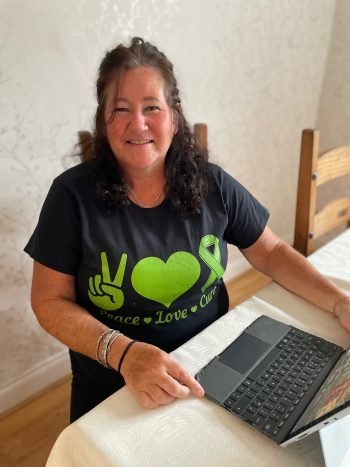
Catherine Mathieson from Holywood in Co Down never imagined that a swelling on her temple in November 2023 would lead to a diagnosis of blood cancer. Initially believing it was connected to an existing condition affecting her eye, she was shocked to discover she had Diffuse Large B-cell Lymphoma.
Now in remission following chemotherapy and immunotherapy treatment at the Ulster Hospital, Catherine is sharing her story during Blood Cancer Awareness Month to encourage others to be aware of the signs and symptoms of Lymphoma and to seek medical advice if something does not feel right.
Diffuse Large B-cell Lymphoma is a common type of Non-Hodgkin Lymphoma. It develops when B-cells become abnormal (cancerous). B-cells are white blood cells that normally help fight infection.
Catherine said, “It was a bit of a shock at the time. I did not know how it was going to work or what was going to happen. I had one lump and then another one started to grow and then a third one appeared. It all happened quite quickly between April and November.”
Having previously experienced a condition affecting her eye, Catherine initially believed the swelling could be related to this. She visited her GP and was prescribed steroids which reduced the swelling. A subsequent CT scan also did not identify anything concerning. However, the lump returned and continued to grow.
It was during a routine visit to have bloods taken that a nurse noticed the swelling and encouraged Catherine to see a doctor. Catherine was referred to the Ulster Hospital where she underwent further investigations including an ultrasound, MRI and eventually biopsies of two lumps. The results confirmed that Catherine had Diffuse Large B-cell Lymphoma.
Catherine began treatment in December 2023, receiving six cycles of R-CHOP, a combination of chemotherapy and immunotherapy, over a period of around four months. She describes the support she received from the Haematology Team in the South Eastern Trust throughout her treatment as incredibly important, particularly from Haematology Nurse Specialist, Emma Kerrigan.
Catherine commented, “Emma was just lovely. She was so approachable and that was the same with all the staff. They were amazing.
“When you are told you have cancer, there are so many things going through your head. You do not know what is going to happen. Having people there who explain things and reassure you makes such a difference.”
Catherine also remembers the emotional impact of losing her hair during treatment and the challenge of going through cancer treatment shortly after losing her mum.
Catherine added, “I think the hardest part for me was that I had just lost my mum before I got my diagnosis. When you are not well and you do not have your mum, it was really difficult. But I was so lucky to have wonderful friends and family around me. They were always there helping me through the journey.”
Following her treatment, Catherine underwent a PET scan which brought the news she had been hoping for.
Catherine stated, “Doctor Ong came back and told me that I was in remission. It was just brilliant. To go from having a large tumour in my head and other tumours and then to have the chemotherapy and immunotherapy work so well was amazing. My hair came back and I am now assessed every six months by Emma. Those appointments give me great reassurance. They do my bloods and check my lymph nodes and if I ever have a concern, I can pick up the phone.”
South Eastern Trust, Haematology Nurse Specialist, Emma Kerrigan, said it is important that people are aware of the signs and symptoms of Lymphoma and do not ignore changes in their health.
Emma explained, “Lymphoma can sometimes be difficult to recognise because the symptoms can be quite general and may be caused by a number of different conditions. Some of the symptoms to be aware of include unexplained lumps or swellings, particularly in the neck, armpit or groin, unexplained weight loss, recurrent infections, drenching night sweats, ongoing tiredness and itching. Deeper swellings which you cannot feel may cause symptoms such as stomach pain, chest pain, coughing and breathlessness.”
“Having one of these symptoms does not necessarily mean that someone has Lymphoma. However, if you notice something that is unusual for you or a symptom that is persistent or getting worse, it is important to speak to your GP and get it checked.”
Emma added, “Catherine’s story is a powerful reminder that listening to your body and seeking medical advice when you notice a change can be so important.”
Catherine hopes that by sharing her experience during Blood Cancer Awareness Month she can encourage others not to delay seeking help.
Catherine commented, “Lymphoma can be a hidden cancer and it can spread quickly. That was the thing that worried me. If you have night sweats, if you are losing weight or if you notice any lumps or bumps, get them checked out. Do not delay.
“I was fortunate that I could see and feel the lumps, but not everyone will. If there is anything at all that you are concerned about, get it checked. It is better to get it checked and find out that it is nothing to worry about.”