


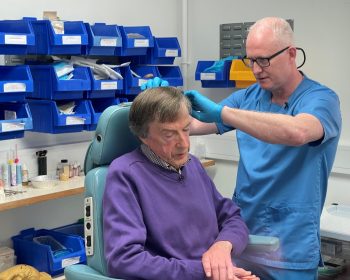
Stephen Gilbert who’s 74 and from Aghalee, was born without a left ear.
He has Microtia, a condition in which the external ear does not fully develop, Stephen also had no hearing on his left side. Over the years he learned to adapt, but as he grew older and hairstyles changed, he became increasingly conscious of the difference.
Thanks to the specialist Maxillofacial Prosthetic Service at the South Eastern Trust, the only service of its kind in Northern Ireland, Stephen now has a prosthetic ear which has changed his life.
And when Stephen’s hearing deteriorated in his right ear, the service went one step further.
South Eastern Trust Maxillofacial Prosthetist, Brian Bigmore had to think outside the box to redesign Stephen’s prosthetic ear so that it could securely accommodate a hearing aid, allowing Stephen to benefit from a crossover hearing system and hear sound from both sides. The innovative solution is just one example of the specialist, highly personalised care provided by the South Eastern Trust’s Maxillofacial Prosthetic Service.
Brian, who is the only Maxillofacial Prosthetist working in Northern Ireland, creating a prosthetic is about much more than replacing a missing part of the body.
Patients are referred to him from across Northern Ireland and from a range of specialties including ENT, plastics and maxillofacial surgery. Many have lost part of their face as a result of cancer or serious injury while others, like Stephen, were born with a condition affecting their facial development.
Brian creates bespoke prosthetics including ears, noses and eyes, carefully matching each one to the individual patient.
Stephen said, “I was born without a left ear or hearing on that side. As I grew up, I became increasingly aware of this difference. When I was younger, I could wear my hair longer and it covered the space where the ear was, so it was not really an issue. As I got into my teenage years, I became more self-conscious. Hairstyles changed and hair started to thin, so there was not the same coverage.”
Stephen initially underwent reconstructive surgery in his teenage years. While the procedure created the general shape of an ear, from skin on his upper left arm, it could not replicate the natural profile and distinctive appearance of his other ear. Years later, his wife read about advances in prosthetics and Stephen decided to explore what was possible.
A referral from his GP brought him to the Ulster Hospital where he underwent surgery to remove the reconstructed ear and have small implants inserted to which his new prosthetic ear could be attached. It was then that he met Brian.
The process of creating Stephen’s prosthetic ear involved great attention to detail, including taking a mould from his natural right ear to recreate its shape, matching the colour to his skin and ensuring the prosthetic fitted securely and naturally against his face.
Stephen stated, “Brian was very good at explaining and showing me what was happening. You could see the new ear basically being formed in terms of a moulding taken from my right ear to give the correct shape. Then, of course, there was getting the right colour to match my cheek and existing ear. We both wanted something that looked as natural as possible. The third thing was getting the closeness of fit. It is obviously quite intricate to get the new ear fitted securely, but also so there is not a gap between the cheek and the top of your jaw where the new ear would be.”
“It takes time and I just want to pay tribute to Brian for his patience and the fact that he spent so much time at it. It was never rushed in any way.”
Years after receiving his first prosthetic ear, Stephen faced another challenge when the hearing in his right ear began to deteriorate. He needed a hearing aid, but a conventional hearing aid could not simply be attached to his existing prosthetic.
That was when Brian began to consider other options.
Working with the hearing requirements of Stephen in mind, Brian redesigned the prosthetic so it could securely accommodate a hearing aid. The result was a specialist prosthetic ear which allows Stephen to use a crossover hearing system, transmitting sound from his left side to his hearing ear.
Brian commented, “It was a unique one for me, but again it is something that patients perhaps have not thought about.”
“As his hearing started to deteriorate on his right side, he needed a hearing aid for meetings and social occasions because he was not able to hear anybody at all on his left-hand side. That was starting to affect him.
“So, I redesigned his prosthetic literally to accommodate the hearing aid. Now he has two ears. He uses one for everyday use and if he is going to a meeting or feels he needs the hearing aid, he puts on his hearing-aid prosthetic and nobody would ever know any different.”
“It is just thinking outside the box.”
Brian added, “The real idea behind it all is to give patients some sort of dignity and quality of life back again. It can be a very, very scary place for them, especially when they are dealing with cancer. When cancer has been removed, the consequence can be a serious defect left behind and that can be very difficult for people. I try my very best to reassure them that it is not the end of the line. There is life after surgery and there is life after facial disfigurement.
“The prosthetics I produce for them are custom made specifically for them. The real idea is to give them their life back and make them feel like they are the same as they were before, that they are normal like everybody else. It means they can go out again, have a coffee or a meal or go to a social occasion and not be afraid that they will stand out or that they are different.
“Sometimes it is simply about being brave enough to leave the house, walk down the street and go for a pint of milk. That is essentially what it is all about, giving them their dignity and quality of life back after such a serious event in their life.”
The impact of the service on Stephen has been profound. He is still getting used to his new hearing aid prosthetic he says having a prosthetic ear in the first place has made a very positive difference to daily living.
Stephen explained, “It is a gradual thing. It is a learning process for my brain to pick up hearing on the left and mix it with what is on the right. I am pleased with the difference it is making for me. It will take time and it is not as good as the real thing obviously, but it is a significant step forward.
“What has been more significant to me has been since the late 1990s actually getting the first prosthetic. You can always manage hearing by saying to people you cannot hear on that side. But having a prosthetic, to me, is a bigger thing, I feel less conscious of my appearance.
“It is amazing. It is never as good as the real thing, but to have something like that and have the service here in the Ulster Hospital is just super. I could not express enough gratitude for it.”
Highlighting the emotional moment when a patient sees their new prosthesis for the first time, Brian said, “There is a range of emotions. It is the very first time a patient receives a prosthetic and it is going to be the first time of many times because it is for life. Those first moments, especially showing them the mirror for the first time, are very emotional for everybody in the room.
“They may have been afraid to look in the mirror for months or afraid that when they put their nose, eye or ear on it would not be what they expected. To see the expression on their face and even their family members who are going through a serious amount of mental trauma as well, they are all in it together.
“It is really heartening to see them smile for the first time in many months and for them to go out proud, not afraid to walk down the street and not afraid even to walk through a hospital corridor.
“To hold their head up high again, that is a big moment.”
The service has meant much more to Stephen than a prosthetic ear, it has helped him feel much more comfortable with his appearance’
Stephen commented, “We are very fortunate to have the service here. I would just say to anybody who is similar to me, or to people who through injury or cancer may need a prosthetic part of their face or neck, that it is wonderful to have the expertise of the specialist Maxillofacial Prosthetic Service.”