


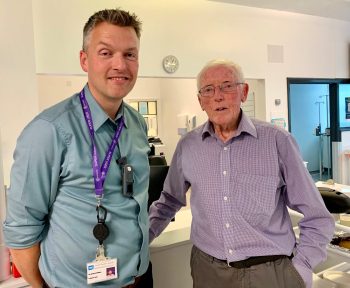
A major new clinical trial supported by the South Eastern Trust is investigating whether commonly prescribed heart medications could help reduce the risk of Dementia in people who have suffered a stroke.
The study, which is taking place across 25 hospitals including the Ulster Hospital, will involve 400 participants from across the United Kingdom. Researchers will examine whether two established prescription medications, currently used to improve blood flow and oxygen supply to muscles, could also improve blood flow to the brain and help prevent vascular damage linked to Dementia.
Following a stroke, some small blood vessels in the brain can be damaged. This can reduce blood flow and lead to Vascular Dementia, a condition that currently has no cure.
One of the participants taking part in the study is 91-year-old James Stevenson from Bangor, who suffered a stroke six weeks ago.
James initially thought he had trapped a nerve in his right hand.
James explained, “I was diagnosed with having had a stroke; I was surprised as I thought it was something simple, but unfortunately it was more than that.
“I have been looked after ever since by the staff at the Ulster Hospital. I am being monitored now as part of this study and I am very happy to take part. I have benefitted from other people’s research in the past.”
As part of the study, James attends regular assessments. James added, “My weight, blood pressure and my hand capabilities are checked and my memory is tested. I have been very impressed by the treatment I have received.”
South Eastern Trust, Consultant Physician, Dr Mark Bowman described the study as an important step forward in improving treatment options for people affected by stroke.
Dr Bowman stated, “If successful, the study could help reduce the risk of cognitive decline and offer new hope to patients and their families. At the minute, we do not have treatments that reduce the risk of cognitive impairment following these types of stroke. We are collecting information from people who have experienced two different types of stroke, cortical and lacunar strokes. We are looking at whether well-established treatments, already used for other conditions, can be repurposed to help reduce the small vessel damage in the brain that can lead to Vascular Dementia.
“It is thanks to participants such as Mr Stevenson and others across the South Eastern Trust that we are able to answer these important questions. We are very grateful for Mr Stevenson in giving up his time.”