


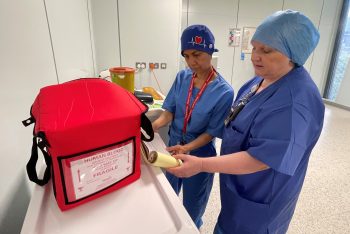
Every day across the South Eastern Trust, donated blood plays a crucial role in helping clinical teams save lives.
As demand for blood remains constant, staff are encouraging eligible members of the public to consider becoming blood donors to help ensure lifesaving blood is always available, when patients need it most.
South Eastern Trust, Theatre Manager, Nikki Henning explained that while advances in surgery and technology have transformed patient care, donated blood continues to be one of the most important resources available to Clinical Teams.
Nikki said, “Blood transfusions are absolutely vital, particularly in theatre, because they can save somebody’s life. No matter how skilled our Surgeons are or how advanced our equipment is, there are situations where we simply cannot save a patient without donated blood.
“In planned surgery, we assess the risks beforehand and ensure blood is available if we think it may be needed. However, emergencies are very different. Patients can arrive following major trauma, severe bleeding, complex cancers or conditions affecting the heart and blood vessels, where every second counts.
“When significant blood loss occurs, the entire Theatre Team works together to control the bleeding, maintain oxygen to vital organs and provide the treatment needed to give the patient the best possible chance of survival. Sometimes that includes a blood transfusion.
“The decision to transfuse blood is made jointly by the Surgical, Anaesthetic and Theatre Teams. Different blood components are required for different situations and in cases of major blood loss, patients may need multiple units of blood.
“We never know when the next emergency will happen or how much blood will be required. That is why it is so important that people continue to donate blood. Every donation helps us care for patients when they need us most.”
Behind every blood transfusion is another dedicated team working around the clock to ensure blood products are available without delay.
Biomedical Scientist, Gemma Magennis, who works in the Blood Bank Laboratory at the Ulster Hospital, explained the importance of the hospital’s Massive Transfusion Protocol during life-threatening emergencies. “A Massive Transfusion Protocol is activated when a patient is experiencing severe, life-threatening bleeding. It requires a rapid, coordinated response involving multiple teams across the hospital.
“As soon as the protocol is activated, our Biomedical Scientists prepare and issue multiple units of blood and blood products, including plasma, platelets and cryoprecipitate, which help replace clotting factors and support the body’s ability to stop bleeding.
“Clear communication between the Blood Bank, Portering Teams and the Clinical Teams is essential to ensure patients receive the right blood products safely and as quickly as possible.
“Having a Blood Bank on site at the Ulster Hospital means we can respond immediately during these emergencies. We also provide blood every day for patients with anaemia, those preparing for surgery and women experiencing complications during pregnancy and childbirth.
“Our blood stocks are replenished daily by the Northern Ireland Blood Transfusion Service, but these supplies are continually being used. Blood has a limited shelf life, so there is an ongoing need for regular donations.”
Gemma encouraged anyone who is eligible to consider becoming a blood donor, “We need people to continue donating blood so that stocks remain available for patients who need them. You never know whose life your donation could help save. By giving blood, you are making a real difference to people and their families at what is often the most difficult time of their lives.”
For further information about becoming a blood donor or to book an appointment, visit https://nibts.hscni.net/donating-blood/where-to-donate/