


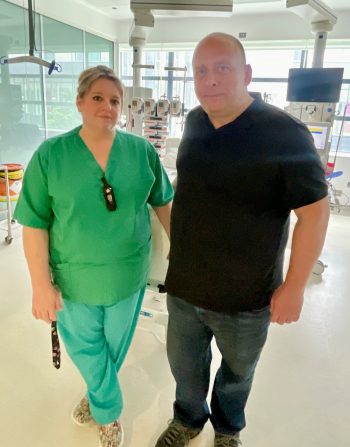
“I didn’t realise how close I came to dying.” These are the words of Bangor man, Adam Bayliss as he reflects on the life-threatening illness that left him fighting for survival in the Intensive Care Unit (ICU) at the Ulster Hospital.
In December 2025, Adam was admitted to ICU after developing Pneumonia that led to Sepsis, multiple organ failure and blood clots. Over the following 11 weeks, he underwent intensive treatment, spending much of that time on a ventilator and in an induced coma while staff worked tirelessly to save his life.
Recognising the long-lasting impact critical illness can have on patients and their families, the South Eastern Trust was one of the first Health and Social Care Trusts in Northern Ireland to establish a dedicated ‘Critical Care Recovery Clinic’. For more than 15 years, the service at the Ulster Hospital has been helping former ICU patients rebuild their confidence, understand their experiences and navigate the complex road to recovery.
While surviving a critical illness is a major milestone, for many patients the physical, emotional and psychological recovery continues long after they leave hospital.
The clinic is designed to support patients and their families after discharge from Intensive Care, providing specialist follow-up for those who have experienced life-threatening illness, prolonged ventilation or lengthy ICU stays. Many patients leave Intensive Care with little or no memory of what happened to them, often struggling to understand the severity of their illness and the impact it may continue to have on their physical, emotional and psychological wellbeing.
Led by a dedicated Multi-Disciplinary Team comprising an ICU Consultant, ICU Nurse, Pharmacist and Physiotherapist, the clinic offers a holistic approach to recovery. Patients receive emotional support, rehabilitation advice, medication reviews and the opportunity to discuss their treatment and recovery with the staff who cared for them during their time in ICU.
A unique aspect of the service is the opportunity for patients and their families to return to the Intensive Care Unit, meet members of the Team who looked after them and visit the bed space where they received treatment. For many, this helps fill gaps in their memory, answer questions and come to terms with what has often been one of the most traumatic experiences of their lives.
One patient who understands the value of this support is Adam. After spending 11 weeks in ICU, much of it unconscious and critically ill, the Critical Care Recovery Clinic helped him understand the seriousness of what he had endured and provided invaluable support as he rebuilt his life.
Adam explained how he was admitted to ICU, “I was in work one day and started feeling unwell. I was shivering and could not get warm. I went home early and later that evening I started coughing up blood. My ex-partner, who is a Nurse, told me to get checked out. The next morning I went to my GP, who found my oxygen levels were dangerously low and sent me straight to the Emergency Department. Within minutes I was in Intensive Care.”
What followed was a battle for survival that Adam remembers very little about. Adam recalled, “I do not remember much from the beginning of December 2025 until the middle of January 2026. I had Pneumonia, Sepsis, multiple organ failure and blood clots. I was placed in an induced coma, put on a ventilator and later had a Tracheostomy. The Doctors and Nurses did an incredible amount of work to save my life.
“When I eventually came round, it was about trying to recover. My breathing improved, the blood clots cleared, but I had to learn to walk again and rebuild my strength.”
Although he spent eleven weeks in hospital, Adam says one of the biggest challenges came after leaving ICU, understanding what had happened to him. Adam said, “I did not realise how sick I was. When you have been in a coma for weeks, there are huge gaps in your memory. There were things I did not understand about my illness, my treatment or what happened while I was unconscious.
“The Critical Care Recovery Clinic has helped answer those questions. It gave me the opportunity to meet the Doctors and Nurses who cared for me, understand what happened and come to terms with everything I went through.”
Adam said the clinic has played a vital role in helping him move forward, “The staff know you because they have been there throughout your journey. They check how you are coping physically and emotionally, how you are getting on with your family and how you are adapting to life afterwards.
“It helps you understand that what you are experiencing is normal and that there are answers available.
“My message to anyone going through something similar is that you are not alone. There are people who understand what you have been through and who can help you make sense of it all.”
ICU Sister, Lucy Wilkinson said the clinic was developed because recovery from critical illness extends far beyond leaving hospital, “The Critical Care Recovery Clinic is for patients who have survived a serious ICU admission. While survival is incredibly important, we also focus on helping people regain their quality of life and supporting them as they return home.
“Many patients have little or no memory of their time in Intensive Care and that can cause significant emotional distress. Through the clinic, we provide assessment, rehabilitation advice, emotional support and a better understanding of what happened during their illness.
“We also give patients the opportunity to return to the unit and visit the bed space where they were cared for. For many people, this is a powerful and emotional experience that helps them understand how far they have come in their recovery.”
Lucy added, “This is an absolutely brilliant service for the emotional wellbeing of patients who have come through some of the most physically and psychologically challenging times of their lives.”
ICU Consultant, Dr David Hendron explained that critical illness often leaves lasting emotional effects long after patients leave hospital, “The vast majority of patients admitted to ICU arrive unexpectedly with life-threatening illnesses. They are often heavily sedated for days or weeks and many have little recollection of what happened.
“We know there can be high rates of anxiety, trauma and post-traumatic stress symptoms following critical illness. The Critical Care Recovery Clinic helps patients fill in the gaps, understand their experiences and regain a sense of control over their journey.
“It gives them an opportunity to ask questions directly, understand the treatments they received and make sense of what happened during a period when they were unable to participate in decisions about their care.”
The clinic’s Pharmacist also highlighted the benefits of the Team’s holistic approach. Mairead McGrath added, “When patients return to clinic, they see the entire Multidisciplinary Team. We review medications, discuss any changes that were made during their ICU stay and ensure they understand their treatment going forward.
“It provides a valuable opportunity to identify any issues, answer questions and make sure patients have the support they need as they continue their recovery.”
For Adam, the Critical Care Recovery Clinic has been invaluable. Adam stated, “The clinic helped me realise just how far I have come.
“When you are lying in a hospital bed fighting for your life, you never imagine you will get back to normal again. Looking back now, I am incredibly grateful to be here and I cannot thank the staff enough.”